
During peak periods
More than 1,000 chemistry and immunology reports awaiting review

With automated review
Nearly 400 reports still awaiting manual review
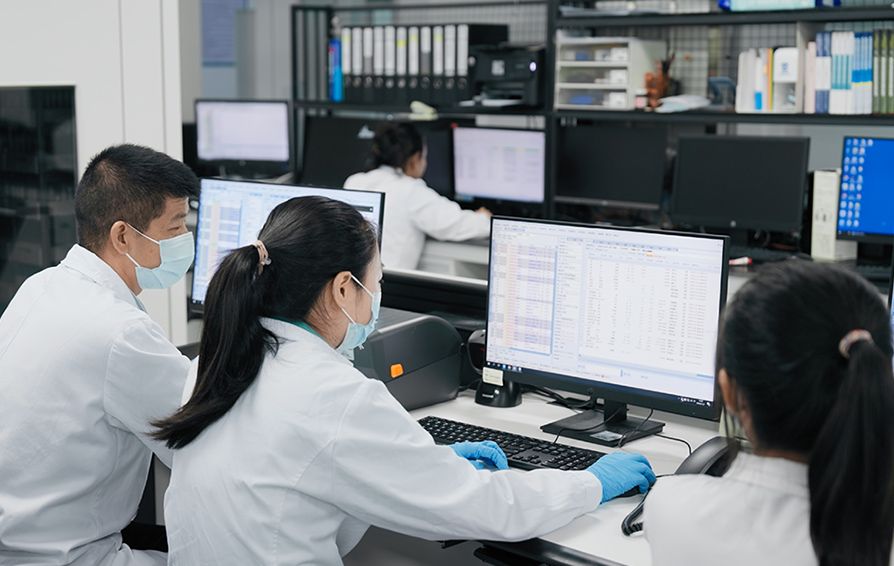
Elevated potassium is a laboratory indicator that appears life-threatening. But could it be due to sample hemolysis, or simply a normal occurrence in a patient with kidney disease? Elevated troponin in an asymptomatic patient—should the result be released?
At the Shenzhen Hospital of Southern Medical University (hereinafter "SMU Shenzhen Hospital"), the Qiyuan Lab AI Model answers these questions by visualizing samples, integrating ECG and other test data, and generating comprehensive analyses. AI assistants are now a reality: they unravel diagnostic complexity, enhance clinical insights, and bring each patient into clearer focus.
Over his ten years at SMU Shenzhen Hospital, senior laboratory physician Guo Weiquan has seen the lab's daily sample volumes surge from hundreds to thousands, recognizing that sample review plays a critical role in ensuring report accuracy.
"Faced with tricky samples, we used to search CNKI and dig through papers one by one, each taking over half an hour," says Guo. "On late-night shifts, you had to force yourself to stay alert even when exhaustion set in. " While years of experience have made such cases rarer for him, junior physicians still face these challenges.
This is a concern shared by Zhang Shichang, Head of the Immunology Section and Quality Manager at Department of Laboratory Medicine, SMU Shenzhen Hospital.

More than 1,000 chemistry and immunology reports awaiting review
Nearly 400 reports still awaiting manual review
Staff shortages, inexperienced personnel, limited capacity—how to address these challenges? As part of the hospital's broader strategy, the department collaborated with Mindray to develop and train the Qiyuan Lab AI Model, with intelligent review as the starting point—a function critical to both report turnaround time and quality.
For tricky samples, the model checks basic elements such as serum quality and instrument status, then factors in the patient's test history and medical records to provide operational and clinical guidance.

"I used to have to click through every single sample," Guo recalls. "If anything looked abnormal, I'd have to review the images and diagnostic opinions, and sometimes pull up ultrasound or X-ray results from four or five different systems. " With information scattered across systems, physicians had to manually review samples to pinpoint those requiring attention, then pull data from multiple interfaces to analyze causes and determine next steps.
Now at SMU Shenzhen Hospital, things work differently. The Qiyuan Lab AI Model filters out at least 30-40% of non-critical samples, allowing physicians to focus on tricky ones and use its review highlights to guide next steps.
For a patient with elevated TSH, the model quickly identified their chronic lymphocytic leukemia, factored in their Hashimoto's thyroiditis history and medication records, and concluded that "no heightened concern is needed." It then suggested consulting with clinicians about possible medication effects and continuing to monitor thyroid function.

Zhang Shichang
Head of the Immunology Section and Quality Manager, Department of Laboratory Medicine, SMU Shenzhen Hospital
Average sample review time has dropped from 30 minutes to 1 minute, with report review accuracy now exceeding 90%, delivering major efficiency gains for the department.
Additionally, the model offers review guidance and reference literature annotated by senior physicians, giving junior staff access to expert insights so they can produce reliable reports.
At noon on Monday, the phone at the Laboratory Medicine Department of SMU Shenzhen Hospital rings three times within half an hour. The calls cover everything from patient result inquiries to questions about test ordering and result interpretation. "Diseases are becoming increasingly complex, with new and unfamiliar conditions emerging all the time," says Guo. This evolving landscape has raised expectations for laboratory medicine, requiring the team to answer more clinical questions and handle more patient calls.
"Many patients ask AI about their results first, but still call us when uncertain—asking what results mean or if more tests are needed," says Guo. He receives patient calls almost every day—the most frequent type of call in his ten years at the department.
At SMU Shenzhen Hospital, the Qiyuan Lab AI Model is enabling real-time dialogue between lab medicine, clinicians, and patients. Take the asymptomatic troponin elevation case mentioned above. Through rapid analysis by the Lab AI Model, the department found that no other tests had been performed on the patient. Following clinical communication, they advised further observation and additional testing to better assess the patient's condition.
As lab medicine becomes more closely integrated with clinical care and patients grow more health-conscious, labs must evolve from issuing basic data reports to providing lab diagnostic reports with in-depth analysis.


"Behind every sample is actually a patient, " says Zhang. He expects the Qiyuan Lab AI Model (domain-specific model) to adapt to emerging diseases, provide personalized interpretations directly on lab reports, improve report interpretability, and bridge the doctor-patient communication gap.

Zhou Hongwei, President of the SMU Shenzhen Hospital, recipient of the National Science Fund for Distinguished Young Scholars and expert with State Council Special Allowance, says that the model can link extensive test data to individual patients over time, enabling better diagnosis and earlier disease detection.
Meanwhile, the integration of laboratory and wearable device data also enables cost-effective and lifelong tracking of key health indicators that supports personalized treatment, chronic disease management, and precision medicine.
How can we trust and adopt AI in healthcare where safety and accuracy matter most? The answer is to train the AI model in the same way we train medical professionals.
Starting in 2025, building on their collaboration with Mindray to feed the AI Model extensive medical literature, guidelines, and standards, over 20 staff at SMU Shenzhen Hospital began manual training. Every day they reviewed real samples and annotated their review process, in order to develop the model's clinical reasoning ability in complex scenarios.

Meanwhile, SMU Shenzhen Hospital partnered with nine hospitals, including SMU Zhujiang Hospital and Affiliated Cancer Hospital and Institute of Guangzhou Medical University, to incorporate over 10,000 expert-annotated complex cases into the Qiyuan Lab AI Model for further training and validation.

"The Qiyuan Lab AI Model is the product of government-healthcare-industry collaboration. A model like this needs a team with strong analytical and research skills plus extensive clinical experience, " Zhou says.
Guided by national and Shenzhen government policies, SMU Shenzhen Hospital spearheaded the creation of the "Shenzhen Laboratory Big Data Industry Chain Sharing and Service Platform" and the "Shenzhen Medical Device Clinical Concept Verification Center." The hospital's 573-square-meter data center with dedicated computing zones offers strong support for the model's implementation.
As a hospital administrator, Zhou Hongwei has witnessed how the Qiyuan Lab AI Model enhances medical efficiency and patient care—and he's convinced the best is yet to come.
"The Qiyuan Lab AI Model integrates various accurate and indicative data to generate diagnostic recommendations, a process that closely resembles how clinicians think," says Zhou, who believes that the model may become the cornerstone of the broader healthcare AI ecosystem.
Zhou Hongwei
President of the Shenzhen Hospital of Southern Medical
University
Recipient of the National Science Fund for
Distinguished Young Scholars and expert with State Council
Special Allowance
We still have a lot to learn about humans and life itself. Many areas remain black boxes that can be investigated through traditional biology as well as AI-assisted methods.
Zhou believes AI's future lies in biomarker R&D, genomic research, pathogen and disease mechanism discovery, and novel target translation. He added, "We aspire to engage more laboratory experts in the Qiyuan Lab AI Model to pool greater collective wisdom. "
On the right side of the first floor at SMU Shenzhen Hospital prominently sits the "Life and Health Narrative Center"—a dedicated space designed for healthcare workers and patients to relax, read, and chat when they need a break. Like the lush green tree rising in the center of the lobby, it symbolizes lives reaching toward one another and the infinite exploration that binds them.
Just as the Qiyuan Lab AI Model is shaped by laboratory professionals and brings each patient into clearer focus, AI will not replace real communication, collaboration, and innovation in the future. Rather, it will nurture the tree of medical diagnostics to grow toward ever greater heights.
